VPM as a Digital Obeya
Obeya is Japanese for "big room." At Toyota it means a room whose walls carry everything a program team needs to steer: the plan, the schedule, the open problems, and the measures of health. The team meets in front of those walls on a fixed cadence, and decisions get made standing up, pointing at the wall, with the people who own the work in the room.
A real obeya, physical or digital, holds everything the project runs on: the technical drawings, the code, the prototypes, the test results, the open problems, and the schedule. Project management is one piece of that room, not the whole of it. VPM supplies that piece: the swimlane diagram, the skyline, the fever chart, and the kanban board form the project-steering wall. If you have read the visualization principles page, you have already seen each of those views on its own. This page describes the room they belong in.
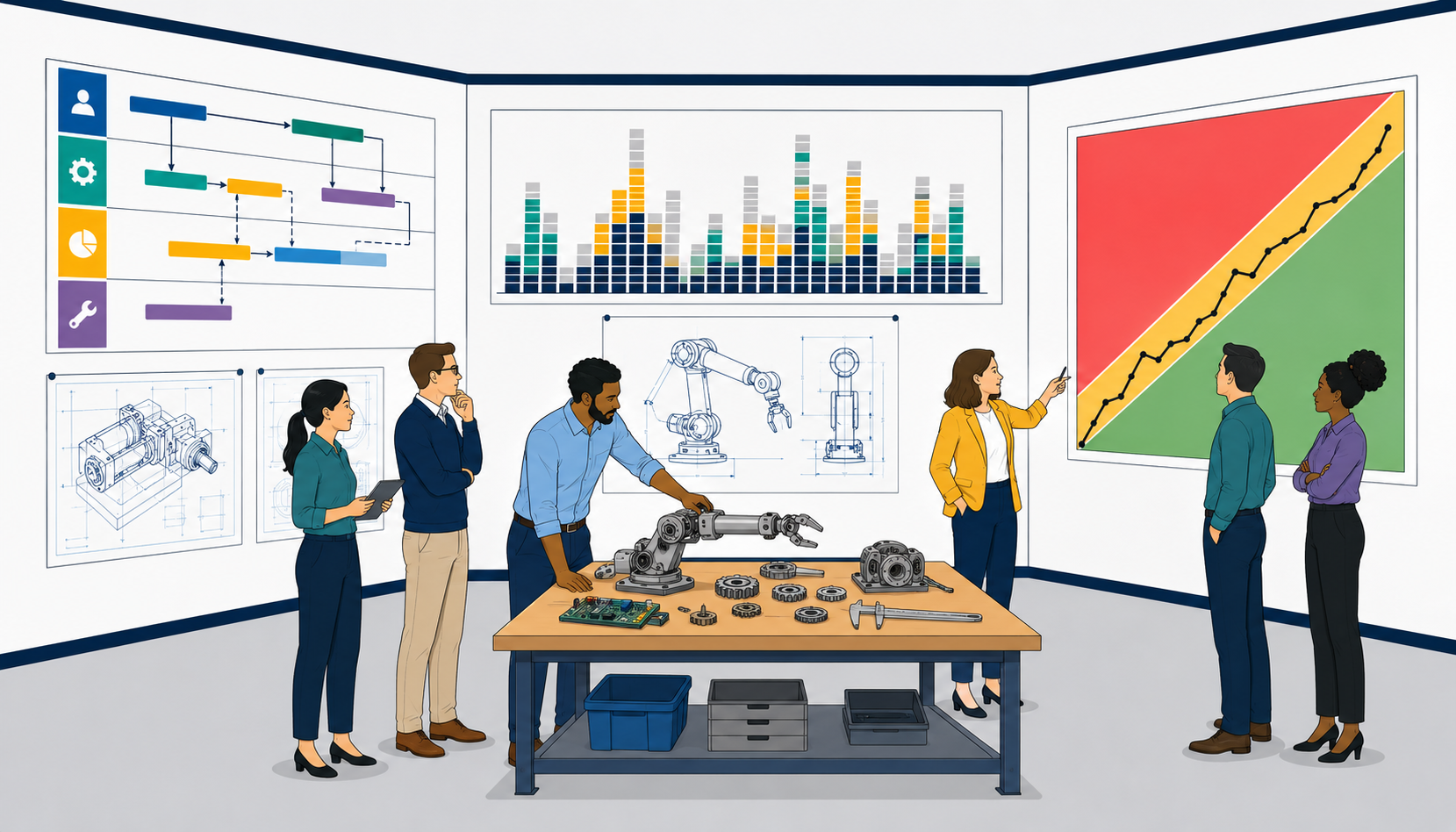
The obeya holds more than charts. Technical drawings hang beside the schedule, and the prototype sits on the table where the team can put their hands on it.
Where the obeya comes from
In the early 1990s Toyota gave Takeshi Uchiyamada the chief engineer role for the G21 program, which became the Prius. Uchiyamada was an unusual pick. He had never been a chief engineer, and he lacked the deep personal networks his predecessors used to pull favors from the functional departments. His response was structural: he brought the leaders of every involved function into one room, put the program's status on its walls, and reviewed it with them face to face on a short cadence. The Prius went from concept approval to launch in roughly half the time of a normal program of that era, and the big room got much of the credit. Toyota then spread the practice across its development programs, and from there it spread through lean product development and lean construction, where it is often called the Big Room.
The lesson is the one VPM is built on: a team aligned around shared, visible truth outperforms a team coordinated through reports and private conversations. Uchiyamada could not rely on authority or relationships, so he relied on the wall.
The steering wall
A physical obeya assigns each wall a job: one carries the design drawings, another the prototype and its test results, another the open problems and A3s in progress. The wall VPM provides is the steering wall, the one that answers "where does the project stand and what needs action?" Four views cover it, each drawn from the same underlying plan rather than maintained by hand:
The swimlane diagram is the plan wall. It shows who owns what, where the handoffs are, and how the phases connect.
The skyline is the progress wall. It shows what the team committed to and what has actually closed, week by week.
The fever chart is the health wall. One line answers the question every sponsor brings into the room: are we still on track, and which way are we trending?
The kanban board is the work wall. It shows what each person is doing today and what is stuck.
On a physical wall these views drift apart, because each is updated by a different person on a different schedule. In VPM they cannot drift: all four are views of the same execution data, so a task that slips moves the swimlane, the skyline, and the fever chart at once. This is the architecture, not documents principle applied to the room itself.
Running the room
A room is only an obeya when the team actually steers from it. The cadence comes from standup meetings: the team meets in front of the views, not around a status spreadsheet. Three habits separate a working obeya from wall decoration. First, the walls are current before the meeting starts, so meeting time goes to decisions instead of updates. Second, problems are stated in front of the wall that shows them, which keeps the discussion on the work instead of on the person. Third, anything the room cannot resolve leaves with a name and a date attached.
The digital obeya when people are separated
When the team lives far apart, getting together in one room every day is not practical, and the obeya has to be simulated with the tools of distributed work. A video call carries the daily meeting. The VPM views, shared on screen, carry the walls. A shared file system carries the documents that would have sat in binders at the back of the room. A message board or team channel carries the hallway conversation, the place where someone flags a concern between meetings instead of waiting for the next standup. Assembled deliberately, these come as close to the big room as distance allows: same cadence, same shared picture, same rule that decisions get made in front of the wall.
Be honest about what is lost. A physical room works on people in ways a screen does not. You walk past the wall on the way to coffee and a slipping task catches your eye without anyone scheduling a meeting. Peripheral awareness, the side conversation that starts because two people are standing at the same chart, the simple social pressure of a red item hanging where everyone passes it, none of this survives the move to video. A call has an agenda and an end time; a room is always on. So the digital obeya is the weaker alternative, and it is worth saying so plainly, because teams that know they are working with a weaker instrument compensate: they keep the cadence tighter, they open the views on every call rather than talking from memory, and they bring the team physically together for the moments that matter most, above all the planning event.
Sometimes the digital room is simply the only way. A distributed team with a disciplined digital obeya will beat a co-located team with no shared wall at all. The room matters less than the rule: one shared picture of the truth, reviewed together, on a cadence.