VPM Works Knowledge Base
Overview
Why Visual Project Management (VPM)?
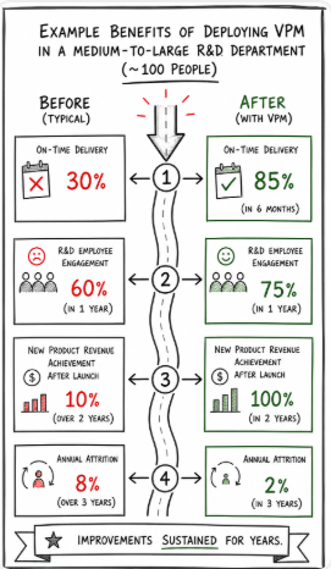
Most companies deliver only 30% of their new product projects on time. The common belief is that projects go wrong somewhere along the way — but the truth is, most start wrong.
Outdated planning methods, weak customer engagement, lack of team buy-in, and poor communication set the stage for failure before work even begins.
This method was built from direct experience, not just frameworks. For a short field example, read A Five-Minute Decision Cost Us Three Months, a real story about how one small missed decision can trigger a large schedule penalty.
Visual Project Management (VPM) fixes this by:
- Building teams that are capable and accountable
- Visualizing progress daily to expose issues in real time
- Driving rapid, team-based responses to delays and information gaps
Start Here First: Proof VPM Works
Before diving into full methodology, start with the measurable outcome story in Proof VPM Works. It shows one coherent operating pattern: remove cross-functional waste first, improve schedule reliability, raise engagement, and produce stronger launch outcomes that hold over time.
Theory of Operation
VPM Works is a handoff-centered operating system for cross-functional delivery: one shared visual plan, one source of truth for schedule health, and rapid Stop-Fix behavior when risk appears. Read the full model in Theory of Operation.
Architecture, Not Documents
This is the core VPM Works inversion: the plan is not a static file, it is a live architecture. One underlying execution truth feeds role-specific views (Task Detail, Task Flow, Skyline, Fever Chart), so every audience sees what it needs without losing alignment.
Using VPM Works Cloud
The Cloud product turns that architecture into daily operating views: My Work for each person's agenda, VPM for cross-functional flow, Gantt for L3 action detail, Skyline for portfolio health, Fever Chart for buffered schedule risk, and task-linked messages for collaboration. Start here when you want product-specific guidance instead of methodology background.
History of VPM
VPM draws on multiple traditions - Critical Chain Project Management, industrial visual planning practices like "Walk the Walls," and swim lane visualization - while adding original innovations including a consensus-based fever chart, structured simplification through handoff focus, and a human architecture of commitment. Read the full history ->
VPM Theory of Operation
For the full end-to-end model, see Theory of Operation.
Using Kanban to Complement VPM for Smaller Projects
Visual Project Management (VPM) is designed for large-scale efforts—typically from 4 developers over 4 months to teams of 50 working for 3 years. But most development teams also support a steady flow of smaller, faster-moving efforts—what we call sustaining projects—ranging from a day of work by one developer to 4 developers over 4 months. These sustaining projects can number in the hundreds or thousands annually, and if unmanaged, they can disrupt the focus and resources needed for VPM-led initiatives. A customized Kanban board can help teams manage these smaller efforts effectively, working alongside VPM to create a comprehensive project management approach for product development. Click Kanban board for smaller projects to see more.
Swim Lane Diagram
Swim Lane organization is the fundamental difference between Gantt and VPM. Gantt charts are useful for listing tasks and dates, but as projects grow, they often become dense timelines where critical handoffs are hard to see. VPM swim lanes make flow visible by function: tasks form clear chains across lanes, ownership is obvious, and coordination gaps stand out immediately. So what? Teams can correct broken handoffs in real time, before delay compounds into missed dates.
Click here to see more about swim lanes.
Role of Critical Path
A critical path is the sequence of tasks that determines a project’s minimum duration—any delay on this path delays the entire project. While the critical path sets the schedule and focuses attention, it’s only a hypothesis at the start. In complex projects, multiple near-critical paths often exist and may shift over time. Actively monitoring and updating the critical path gives the most accurate picture of current project risk and timing.
Click here to see more about the role of critical path.
Wasteful Automation
Many teams are eager to automate project processes—auto-calculated critical paths, automatic emails, self-adjusting schedules. But successful projects require an intelligent eye on every scope change, task expansion, and delay. Without that, automation can quietly lock in decisions that cause failure long after the fact. Click link to see more.
Click here to see more about wasteful automation.
Team Selection
Selecting the right team is one of the most critical decisions in any project. Success hinges not just on having smart people involved—but on assembling a group that has all the capabilities needed, and just as importantly, the availability to contribute when it matters most. Too often, projects stall or suffer because key skills are missing or team members are stretched too thin.
To keep the team focused and efficient, we organize it into two levels:
The core team is small, dedicated, and deeply involved in the day-to-day work and decision-making. These are the people who attend all key meetings and own major deliverables.
The extended team includes subject matter experts, support functions, and other contributors who may not be full-time but are vital for specific parts of the project. They’re pulled in as needed.
This structure keeps communication crisp and allows the core team to move quickly—while still ensuring the full breadth of expertise is available to the project.
VPM Stand-Up Meetings
VPM stand-up meetings are short, focused sessions designed to maintain momentum, surface issues early, and keep teams aligned. Like Agile daily stand-ups, they’re fast-paced (usually 15 minutes or less), happen at a regular time, and are intended to be lightweight. The key difference lies in the visual context—VPM stand-ups happen in front of a shared project visualization, such as a wallboard, whiteboard, or digital canvas that reflects current project status.
VPM: a Visual Single Point of Truth
VPM uses one shared operational truth so teams do not spend execution time reconciling conflicting status sources. In buffered mode, fever-chart behavior strengthens this by creating earlier and clearer alarm signals. See Theory of Operation and Buffer Methodology.
Visualization Principles
VPM visual design follows three principles: prioritize hierarchy over flat task lists, make cross-functional handoffs visually prominent, and present status so teams can act immediately.
Click here to see more about visualization principles.
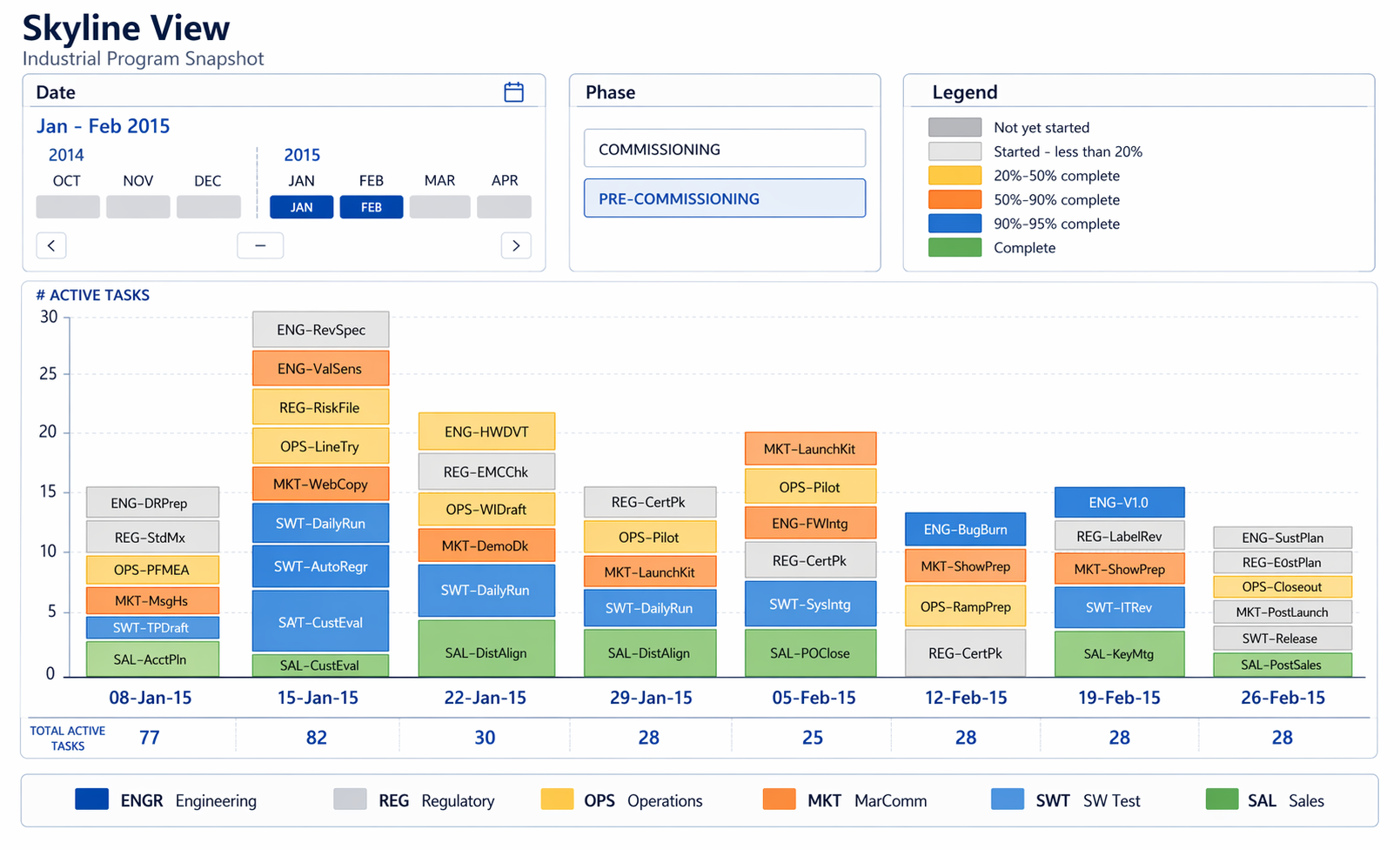
Skyline Visualization
Adapted from GE's Line of Balance (LOB) technique. A stacked status snapshot that counts deliverables by health status (on time, late, future) and slices by project, discipline, sub-discipline, or individual. Complementary to the Fever Chart: Skyline shows "where are we now?", Fever Chart shows "where are we heading?"
Click here to see more about skyline visualization.
Multi-Phase and Single-Phase Projects
In Visual Project Management (VPM), a project phase typically spans 3 to 6 months—long enough to achieve meaningful progress, yet short enough to maintain a strong sense of urgency where each week (and ideally each day) matters. VPM is designed to support both single- and multi-phase projects, though its primary use case is multi-phase initiatives.
Creating Ownership and Accountability
- The flaw of Project-Manager Planning
- Create a Team Mentality
- People will do more not to let down teammates than the boss — Patrick Lencioni
- Create Accountability at Planning; Nurture at Daily Stand-ups
- The Planning Event: in-person, virtual, and schedule compression
Agile, Waterfall, and VPM
- The cost of iteration determines the right methodology — it's a spectrum, not a choice
- Both Agile and Waterfall fail at cross-functional handoffs — the space between teams
- VPM is the coordination layer that manages interfaces, not internal processes
- RACI handoffs are the glue: the interface contract between teams regardless of methodology
Central Role of Planning Event
The planning event is where a project becomes a real team instead of a collection of functions. Complex projects carry hidden dependencies, implicit assumptions, and cross-functional constraints that rarely surface in isolated planning. Bringing the core group together for extended, focused conversation creates the richest signal: people can challenge assumptions in real time, expose handoff risk early, and align on what "done" actually means across lanes.
It is also the moment of ownership. VPM depends on each lane owner reaching an explicit commitment state: "I agree, and I own what happens in my lane." That matters later when the project hits turbulence. Teams that went through a true planning event show up as problem solvers under pressure because they remember helping build the plan; teams that did not often default to passive status updates and blame-shifting.
The event also functions as an organizational start signal. When leadership marks the planning event as the official beginning of execution, priority conflicts become easier to resolve because approval is unambiguous. People know the work is authorized, staffed, and expected to move. This reduces political drag and protects the project when resource contention appears.
In practice, the planning event builds the behavioral foundation VPM needs: shared goals, shared understanding, explicit ownership, and shared commitment to fast correction when reality shifts. See Project Planning Event for the operating structure.
Phase-Gate Systems
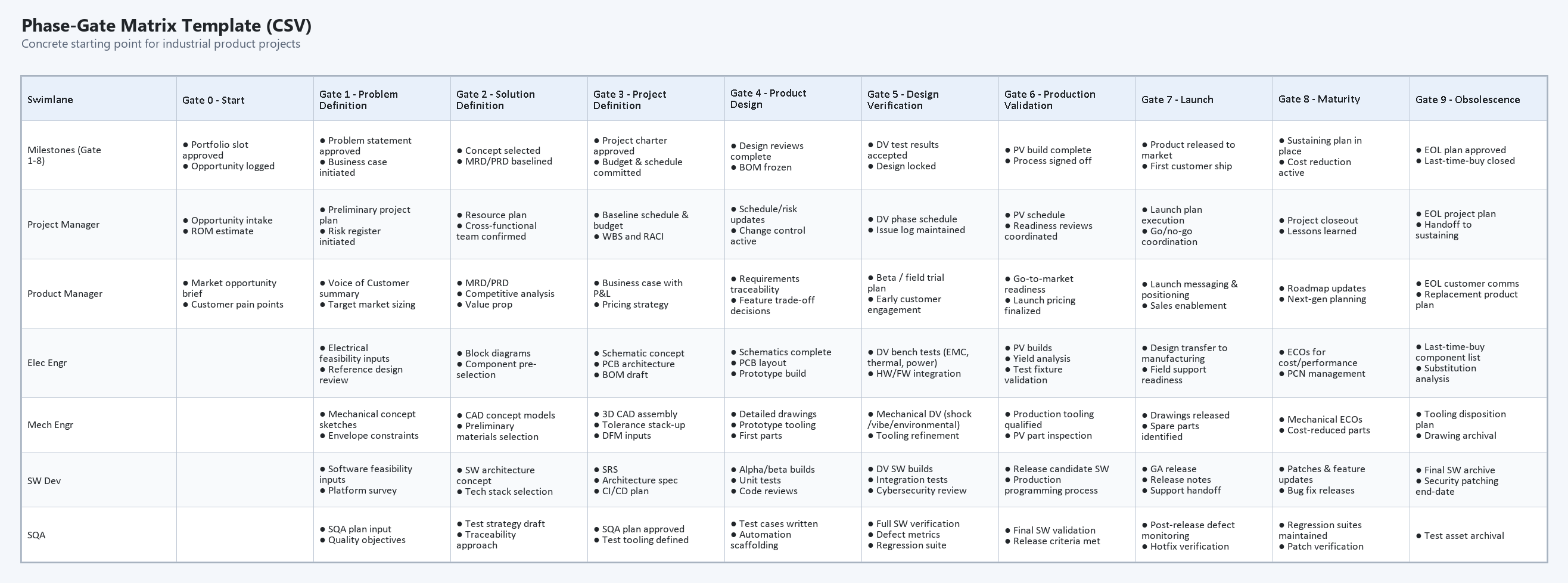
Phase-gate systems define the maturity checkpoints that guide investment and risk decisions from concept to launch. Used well, they free experts rather than constrain them: teams use the matrix as the minimum floor, add project-specific value-creation work, and explicitly mark non-applicable items with rationale so creativity and discipline stay visible together. See the full practical guide and examples in The Most Misunderstood Part.
Here is a concrete starting point for industrial product projects: download the Phase-Gate Matrix template (CSV).
Quality Management Systems (QMS)
QMS defines how work is performed, documented, reviewed, and improved. In practice, phase-gate governs major go/no-go decisions, QMS governs evidence quality and process discipline, and VPM manages day-to-day execution flow between gates.
Adopting VPM
- Project Start
- Phase Start
- Mid Phase
The VPM Works Process
VPM turns complex programs into a repeatable execution rhythm across four stages:
- Planning Event Preparation — align goals, inputs, and participants.
- Planning Event — build the visual plan and handoff commitments together.
- Project Execution — run standups, track handoffs, and correct flow early.
- Launch Sustainment — stabilize launch and capture improvement learning.
Click here to see the full VPM Works Process.
Certification
Certification builds adoption confidence by validating practical VPM operating behavior, not just vocabulary.
VPM and Design Thinking
Design Thinking clarifies what to build; VPM provides the cross-functional execution system to deliver it reliably.