Phase-Gate Systems
If you have spent years in product development, phase-gate can feel obvious. But for many teams, especially in smaller companies, it is still unfamiliar or only partly implemented. That creates a predictable problem: teams work hard, but the business still gets late surprises, weak launch readiness, and avoidable rework.
A good phase-gate system does not remove uncertainty. It gives uncertainty a disciplined path. It helps teams mature a product from idea to market through explicit decision points, with increasing evidence and increasing investment.
If you want the quality-discipline side specifically, see Quality Management Systems (QMS).
What a Phase-Gate System Is
A phase-gate system (often called stage-gate) separates product development into:
- Phases (or stages): where cross-functional work gets done.
- Gates: where leaders decide whether to continue, redirect, hold, or stop.
In mature systems, each gate has three things:
- Required deliverables from the phase just completed.
- Evaluation criteria (technical, market, financial, operational, risk).
- A resource decision for the next phase (people, budget, timing).
That last point matters. A gate is not just a status meeting. It is a business commitment event.
Lean Thinking and Single-Piece Flow
From a Lean perspective, a full project is a very large batch of work. Large batches hide problems, delay feedback, and create long waits between decisions. Phase-gate improves that by breaking the project into smaller maturity batches (phases), then breaking each phase into standard deliverables and standard tasks. That is how teams create practical standard work across functions and move one project through the lifecycle with better single-piece flow: define the expected work at each step, complete it to a clear standard, review it at the gate, and move forward without carrying unresolved ambiguity into the next phase.
Why Phase-Gate Was Created
The modern form was developed and popularized in the 1980s and 1990s by Dr. Robert G. Cooper and others studying new product success/failure patterns. The practical goal was straightforward:
- Stop funding weak projects too long.
- Fund strong projects earlier and more deliberately.
- Create common cross-functional checkpoints.
- Improve launch quality and commercial outcomes.
In other words, phase-gate was designed to make project progress more predictable, not by pretending risk goes away, but by exposing risk early and making investment decisions in steps.
Who Uses Phase-Gate Today
People often associate phase-gate with big consumer or industrial companies, but the logic is broader than that. Variants are used across:
- Industrial product development.
- Automotive and supplier ecosystems.
- Energy and large capital programs.
- Government and defense acquisition lifecycles.
- Research and technology programs that use formal decision milestones.
Different sectors use different names: gates, key decision points, milestones, critical decisions, or lifecycle reviews. The pattern is the same: work is matured in phases; progression requires evidence.
What Phase-Gate Is For
At its best, phase-gate does five jobs for an organization:
- Governance: leadership can make forward-looking resource decisions with clearer data.
- Standards: teams know what "ready" means at each maturity point.
- Risk Control: high uncertainty is handled earlier and with smaller investments.
- Cross-Functional Alignment: engineering, operations, commercial, quality, and supply chain decisions stay synchronized.
- Portfolio Discipline: weak projects are stopped earlier; priority projects are staffed deliberately.
If a company says "we have phase-gate" but still approves work without clear evidence or without committed resources, it has process theater, not true gate governance.
The Most Misunderstood Part: Phase-Gate Is a Guide, Not a Law
The phase-gate matrix is the organization's minimum expected discipline. It is the floor, not the finished product.
Customers do not buy because a team checked every box in a gate template. They buy when teams combine governance discipline with project-specific value creation.
In many real projects, one schedule carries three layers of work:
- Applicable phase-gate tasks (~55%): the relevant matrix cells that truly apply to this project.
- Project-specific "secret sauce" (~30%): differentiating tasks that make the product worth buying, planned in the same swim lanes and gate timing.
- Explicitly excluded phase-gate items (~15%): items marked N/A with rationale, rather than silently dropped.
Treat those percentages as a practical pattern, not a rule. The exact mix changes by product class, risk profile, and business context.
The key discipline is transparent scoping:
- Build the plan from the gate items that apply.
- Add the project-specific work that creates market value.
- Call out what is excluded, and why, so scope decisions are reviewable.
This is closer to clinical practice than legal compliance. A medical guideline gives a doctor norms, known risks, and proven checks, but it does not replace judgment for a specific patient. Phase-gate works the same way for product teams.
A Project Is Not the Matrix; It Is the Matrix Plus Judgment
If a project plan is copied directly from the matrix with no tailoring, two problems usually appear:
- Differentiation work is missing because the team over-focused on template completion.
- Reviewers cannot tell whether dropped items were intentionally excluded or accidentally forgotten.
That is why mature teams force visibility on all three categories:
- Applicable matrix work.
- Added project-specific work.
- Explicit N/A decisions with rationale.
This format protects both governance and creativity. Governance gets evidence and traceability. Experts get room to solve the real product problem.
Why This Builds Experts Instead of Automating Them
Good phase-gate use does not reduce experts to checklist operators. It removes repetitive baseline debates so expert effort can move to higher-value decisions:
- Which risks are unique to this project and need early burn-down.
- Which trade-offs create market advantage and are worth schedule or cost.
- Which matrix items are irrelevant in this context and should be marked N/A.
In other words, the matrix handles the mundane floor so expert judgment can concentrate on novelty, complexity, and value creation.
Practical Tailoring Workflow (Use at Planning and at Every Gate)
- Start with the full gate matrix as a candidate list, not a fixed contract.
- Mark every item one of three ways:
Apply,Add, orN/A. - For every
N/A, record one short reason so the decision is auditable. - For every
Add, place it in a lane and gate like any other accountable task. - Recheck the mix at each gate transition because applicability can change as learning increases.
This simple routine prevents silent scope drift in both directions: silent omissions and silent gold-plating.
Example Scoping Decisions (Real-World Complexity)
Example 1: Derivative Product, No New Certifications
- Apply: Core design verification, pilot readiness, launch readiness.
- Add: New field-install procedure validation for a revised mounting method.
- N/A: Gate 2 regulatory standards expansion matrix, because no new markets or cert classes are introduced.
Result: the team does not waste time on non-events, but still adds project-specific work needed for customer success.
Example 2: Existing Hardware, New Cloud Analytics Offering
- Apply: Problem definition, architecture selection, cybersecurity verification, launch readiness.
- Add: Data governance, model monitoring, customer data retention workflow, incident response simulation.
- N/A: New factory process validation, because no hardware manufacturing change is in scope.
Result: the matrix keeps discipline, while the plan expands into software-service risks not captured in a hardware-heavy baseline.
Example 3: Platform Refresh with Aggressive Cost-Down Target
- Apply: Business case refresh, supplier readiness, quality controls, launch gates.
- Add: Value-engineering sprint cycle, dual-source negotiation track, service-part interchangeability test.
- N/A: New technology feasibility studies already proven on the current platform.
Result: experts spend their time on economic and operational leverage, not re-proving known fundamentals.
The Leadership Test
At each gate, reviewers should be able to answer four questions quickly:
- What matrix work was required and completed?
- What project-specific work was added and why?
- What matrix items were marked N/A and why?
- Does this mix still support business value, risk posture, and launch readiness?
When these answers are visible, phase-gate becomes an expert system for decision quality, not a bureaucratic script.
VPM is built for this reality. It does not turn experts into automatons. It helps experts apply judgment deliberately, make trade-offs visible, and execute with clearer cross-functional ownership between gates.
Typical Structures (There Is No Single Universal Model)
Most organizations use 5-7 major development phases. Some run lighter versions for low-risk updates and fuller versions for platform or new-technology bets.
The exact names vary, but the logic usually includes:
- Problem/opportunity definition.
- Solution or concept definition.
- Project definition/business case.
- Design and development.
- Verification/validation.
- Production readiness.
- Launch and post-launch learning.
Your current 0-9 structure is strong for industrial product work because it separates early strategic clarity from late execution readiness and explicitly includes maturity and obsolescence.
Example 0-9 Gate Model for Industrial Product Development
Below is a practical reading of your gate map. This is not the only valid map, but it is clean, teachable, and operationally useful.
Gate 0 - Start
- Opportunity is real enough to assign meaningful resources.
- Leadership agrees this is a project, not background exploration.
- Initial scope boundaries and core team assumptions are defined.
Gate 1 - Problem Definition
- Customer/user problem is explicit and testable.
- Strategic fit is clear.
- Team is aligned on what problem will and will not be solved.
Gate 2 - Solution Definition
- Candidate solutions are screened.
- Preferred solution direction is selected with rationale.
- Critical unknowns and major feasibility risks are visible.
Gate 3 - Project Definition
- Integrated business and execution baseline exists.
- Scope, cost, schedule, and ownership are explicit.
- Leadership commits resources for full development.
Gate 4 - Product Design
- Design reaches maturity needed for formal verification.
- Major cross-functional design decisions are resolved.
- Manufacturing, service, and quality implications are addressed early.
Gate 5 - Design Verification
- Product is verified against defined requirements.
- Defects and gaps are closed to agreed thresholds.
- Team can state what is proven, what is not yet proven, and why.
Gate 6 - Production Validation
- Build and process evidence demonstrates repeatable production readiness.
- Supply chain, quality controls, and operations readiness are credible.
- Remaining launch risks are explicitly accepted or mitigated.
Gate 7 - Launch
- Commercial release is authorized.
- Market, sales, support, and operations are coordinated.
- The organization shifts from proving to performing.
Gate 8 - Maturity
- Product enters steady-state management.
- Cost, quality, service, and lifecycle optimization become primary.
- Learning feeds next-generation roadmaps.
Gate 9 - Obsolescence
- End-of-life is planned, not improvised.
- Customer migration and service continuity are managed.
- Technical, commercial, and supply closure are executed cleanly.
Why Start and Launch Gates Deserve the Most Diligence
In most companies, two gates carry the strongest business consequences.
1) Project Start (Gate 0 / early Gate 1)
This is where real money and people are committed. Once headcount and calendar time are assigned, sunk-cost behavior starts. A weak start gate creates a long tail of recovery work:
- Teams solve the wrong problem efficiently.
- Priority conflicts are hidden for months.
- Late redefinition damages trust and schedule credibility.
A rigorous start gate should answer: Why this? Why now? Why us? What evidence is still missing?
2) Launch (Gate 7)
This is where internal effort turns into market consequence. A weak launch gate can erase years of strong engineering through poor readiness in service, supply, quality, documentation, or commercial execution.
Launch diligence is not bureaucracy; it is enterprise risk control. The biggest launch failures are usually integration failures between functions, not single-discipline mistakes.
Practical Example: Critical Few by Gate
Example Product Mix (Lightly Regulated Industrial)
- Benchtop particle counter (hardware equipment + embedded software).
- Wireless vibration-monitoring sensor kit (hardware + firmware + cloud software).
- Automated torque calibration station (industrial equipment + controls software).
- High-temperature adhesive cartridge line (consumable product with process settings and application guidance).
Gate 1: Problem Definition (Critical Few)
- Clear problem statement with quantified pain and target user: Why: prevents teams from solving an interesting problem instead of the real business problem.
- Segment and application definition (where we will and will not play): Why: keeps scope from drifting into low-value adjacencies.
- Competitive baseline and current alternatives: Why: defines the real bar to win, not an internal wish list.
- Success criteria (technical + commercial) with explicit out-of-scope: Why: creates a stable decision frame for later trade-offs.
Gate 2: Solution Definition (Critical Few)
- 2-3 concept options with trade study (cost, performance, complexity, risk): Why: avoids locking in a weak architecture too early.
- Preferred architecture with top technical risks called out: Why: gives leadership confidence that key unknowns are understood.
- Proof-of-concept evidence for highest-risk assumptions: Why: converts opinion into data before major spending.
- Preliminary make/buy and platform reuse strategy: Why: reduces avoidable reinvention and downstream cost.
Gate 3: Project Definition (Critical Few)
- Integrated baseline for scope, schedule, resources, and budget: Why: this is where the business makes a real investment commitment.
- Cross-functional ownership model (RACI at accountable-task level): Why: removes ambiguity before execution pressure rises.
- Risk register with burn-down plan and contingency triggers: Why: defines how the team will respond when risks become real events.
- Business case refresh (cost, price, margin, volume assumptions): Why: confirms the project still deserves priority.
Gate 4: Product Design (Critical Few)
- Released design package at required maturity: Why: verification fails when design intent is still moving.
- DFM/DFA/serviceability review closure: Why: catches late-stage manufacturability and support issues early.
- Supplier and tooling readiness decisions for critical parts: Why: long-lead mistakes here often become launch delays.
- Finalized design verification plan with requirement traceability: Why: ensures the right tests are run for the right reasons.
Gate 5: Design Verification (Critical Few)
- Requirement-by-requirement verification results: Why: provides objective evidence of conformance.
- Reliability and stress-test results for real use conditions: Why: protects field performance and warranty outcomes.
- Defect disposition and closure status against agreed thresholds: Why: prevents �passing the gate with open wounds.�
- Claims substantiation for commercial messaging: Why: aligns what we market with what we can prove.
Gate 6: Production Validation (Critical Few)
- Pilot/PV run evidence: yield, throughput, and process capability: Why: demonstrates repeatable build performance, not one-off success.
- Control plan, work instructions, and operator training complete: Why: converts engineering intent into stable production behavior.
- Supplier readiness and incoming quality controls verified: Why: launch quality is often a supply-chain problem before it is a factory problem.
- Service readiness (spares, diagnostics, documentation, support workflow): Why: protects customer experience in the first 90 days after release.
Gate 7: Launch (Critical Few)
- Regional or channel go/no-go checklist signed: Why: market readiness is rarely uniform across regions.
- Commercial readiness (pricing, collateral, sales enablement, forecast): Why: great engineering fails commercially without execution readiness.
- First-90-day monitoring and escalation plan: Why: early detection prevents small launch issues from becoming brand events.
- Leadership alignment on stop-fix triggers and response owners: Why: speed of correction is usually more important than perfect initial conditions.
Honorable Mention: Gates 8 and 9
- Gate 8 (Maturity) and Gate 9 (Obsolescence) are essential for lifecycle performance, margin protection, and customer continuity.
- They usually do not carry the same front-end investment commitment intensity as Gates 1-3, or the same immediate market risk intensity as Gate 7.
- Still, disciplined execution at Gates 8 and 9 is where companies protect long-tail profitability and preserve customer trust.
Where teams get in trouble is not usually in the gate deck itself. Trouble appears between gates: handoffs are unclear, risks are seen late, and recovery starts too slowly.
That is exactly where VPM contributes the most.
Where Phase-Gate Alone Is Not Enough
Phase-gate is a governance framework. It is not a day-to-day execution control system by itself. Common failure modes include:
- Gate reviews are strong, but between-gate execution drifts.
- Deliverables exist, but ownership is diffuse.
- Teams report status, but do not trigger immediate stop-fix behavior.
- Program managers carry coordination load alone while functions remain siloed.
If this sounds familiar, the issue is usually not "bad gate design." It is missing execution operating rhythm between gates.
How VPM Complements Phase-Gate
Phase-gate tells the organization when decisions must be made and what maturity is required.
VPM improves how work flows between those decisions:
- Swim Lane visibility clarifies cross-functional handoffs.
- Accountable-level planning reduces noise and improves ownership.
- Stand-up cadence surfaces risk before it compounds.
- Buffer and fever-chart logic improve recovery timing.
A practical rule that works: use phase-gate for investment and maturity decisions; use VPM for daily control and coordination between those decisions.
Download a Practical Phase-Gate Template
Here is a concrete starting point for industrial product projects.
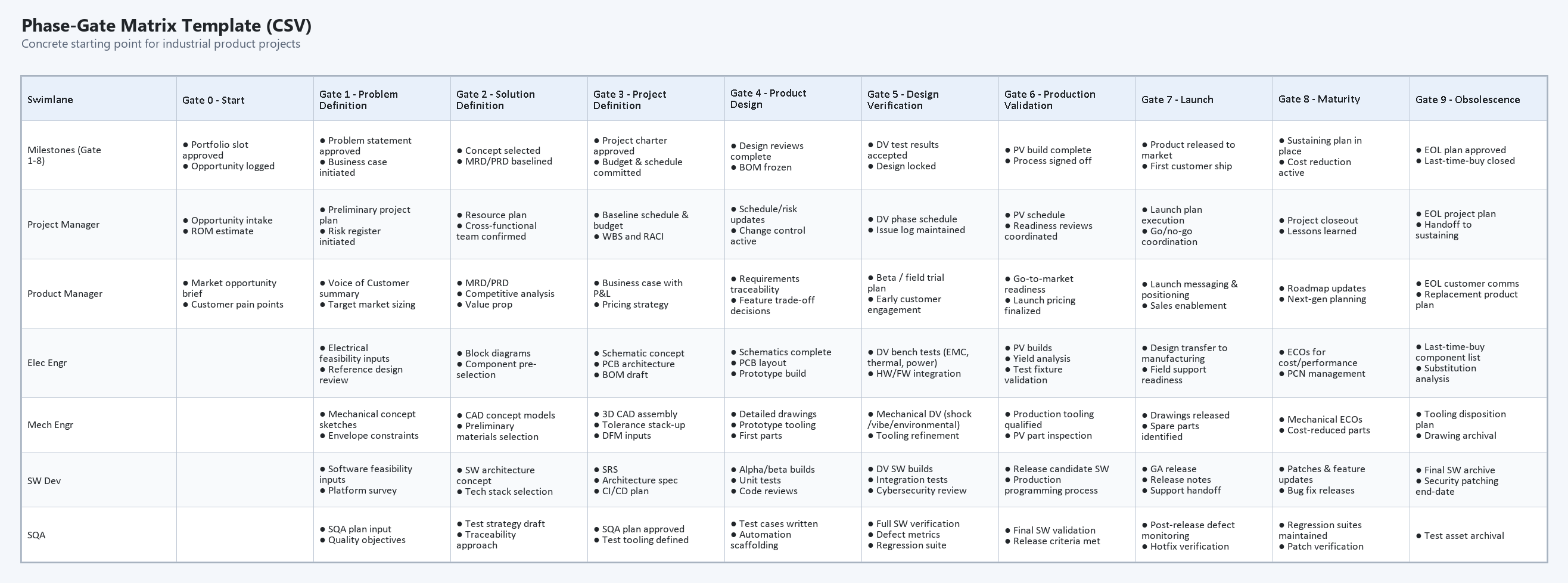
Use this starter matrix to operationalize gate deliverables by swim lane:
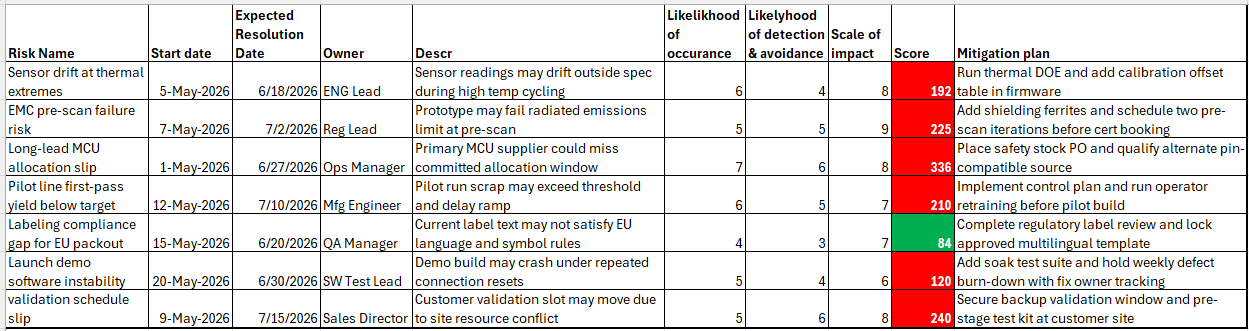
The risk register view is derived directly from the same live project data that drives the swim-lane plan. It is not a separate tracker that must be maintained in parallel.
Use it as a complementary lens:
- Swim-lane view: cross-functional flow, handoffs, and timing.
- Risk register view: concentrated risk signal, ownership, and mitigation status.
It is intentionally designed as a working template, not a rigid standard. Tailor gate names, deliverables, and evidence depth to your product class, risk level, and organization maturity.
Themes That Move Across the Whole System
This matrix is a strong starting point, but the real power appears when teams manage the threads that run across multiple gates, not just the checklist inside one gate.
Think in through-lines:
- Requirements -> Design -> Validation -> Claims: customer need becomes requirement, requirement becomes design choice, design choice is verified, and verified evidence becomes trustworthy launch messaging.
- Risk -> Experiment -> Control: early unknowns are made explicit, the highest-risk assumptions get tested first, and proven controls are carried into production and service.
- Architecture -> Integration -> Readiness: concept architecture decisions in early gates must survive cross-functional integration in Gates 4-6 before launch confidence is real.
- Supply and Operations -> Customer Experience: supplier readiness, process capability, service documentation, and spares planning directly shape first-90-day customer outcomes.
- Learning -> Next Cycle: what is discovered in verification, launch, and maturity should feed the next generation so phase-gate becomes a learning engine, not a compliance event.
Example of Cross-Gate Continuity in Practice
- Requirements thread: Gate 1 captures user pain and success criteria, Gate 3 baselines requirement ownership, Gate 5 proves each requirement with traceable evidence, Gate 7 ensures external claims stay inside what was proven.
- Design thread: Gate 2 selects a concept with known trade-offs, Gate 4 resolves design details and interfaces, Gate 5/6 confirms the design works under real conditions and in repeatable builds.
- Validation thread: Early proof-of-concept reduces uncertainty, design verification confirms conformance, production validation proves repeatability, launch monitoring confirms field reality.
When teams work this way, phase-gate does not reduce creativity. It creates a stable backbone for it. The mundane baseline is handled systematically so experts can spend energy on the decisions that actually create value.
Final Advice for Smaller Companies
If your organization has little phase-gate exposure, do not over-design the first version.
Start with:
- Clear gate definitions.
- A short deliverable list per gate.
- Explicit gate decision outcomes.
- Named accountability for each major deliverable.
- One visible mechanism to control work between gates.
Then improve each cycle. Mature phase-gate systems are built through use, not through perfect first drafts.
References
- Cooper, R.G. (1990). Stage-Gate Systems: A New Tool for Managing New Products (Business Horizons). DOI: 10.1016/0007-6813(90)90040-I
- Cooper, R.G. (1994). Third Generation New Product Process (Journal of Product Innovation Management). DOI: 10.1016/0737-6782(94)90115-5
- Stage-Gate International, The Stage-Gate Model: An Overview: stage-gate.com/blog/the-stage-gate-model-an-overview
- Stage-Gate International, Discovery-to-Launch Process: stage-gate.com/about/stage-gate-innovation-performance-framework/discovery-to-launch-process
- NASA Systems Engineering Handbook, Program/Project Life Cycle and Key Decision Points: nasa.gov/reference/3-0-nasa-program-project-life-cycle
- NASA NPR 7120.5, management based on lifecycle phases and KDPs: nodis3.gsfc.nasa.gov/displayDir.cfm?Internal_ID=N_PR_7120_005F_&page_name=Chapter1
- U.S. DOE/NNSA example of Critical Decision governance in project definition: energy.gov/nnsa/articles/nnsa-approves-critical-decision-1-los-alamos-plutonium-pit-production-project