Swim Lane AND Gantt: The Best of Both
The fundamental visualization difference between VPM and traditional Gantt is the swim lane diagram.
This page explains why both the swim lane view and the Gantt view tell you more about project reality together than either does separately.
This page captures a practical truth most teams feel in execution:
- The Gantt Trees view shows all the detailed work, but the plan is brittle.
- The VPM Forest (Swim Lane View) shows clean flow, but some detail foundation is lost.
- VPM Works: The Forest and the Trees keeps the flow and reconnects it to the detailed work.
The figures use home construction as an accessible example, but the method is built for product development and scales across domains.
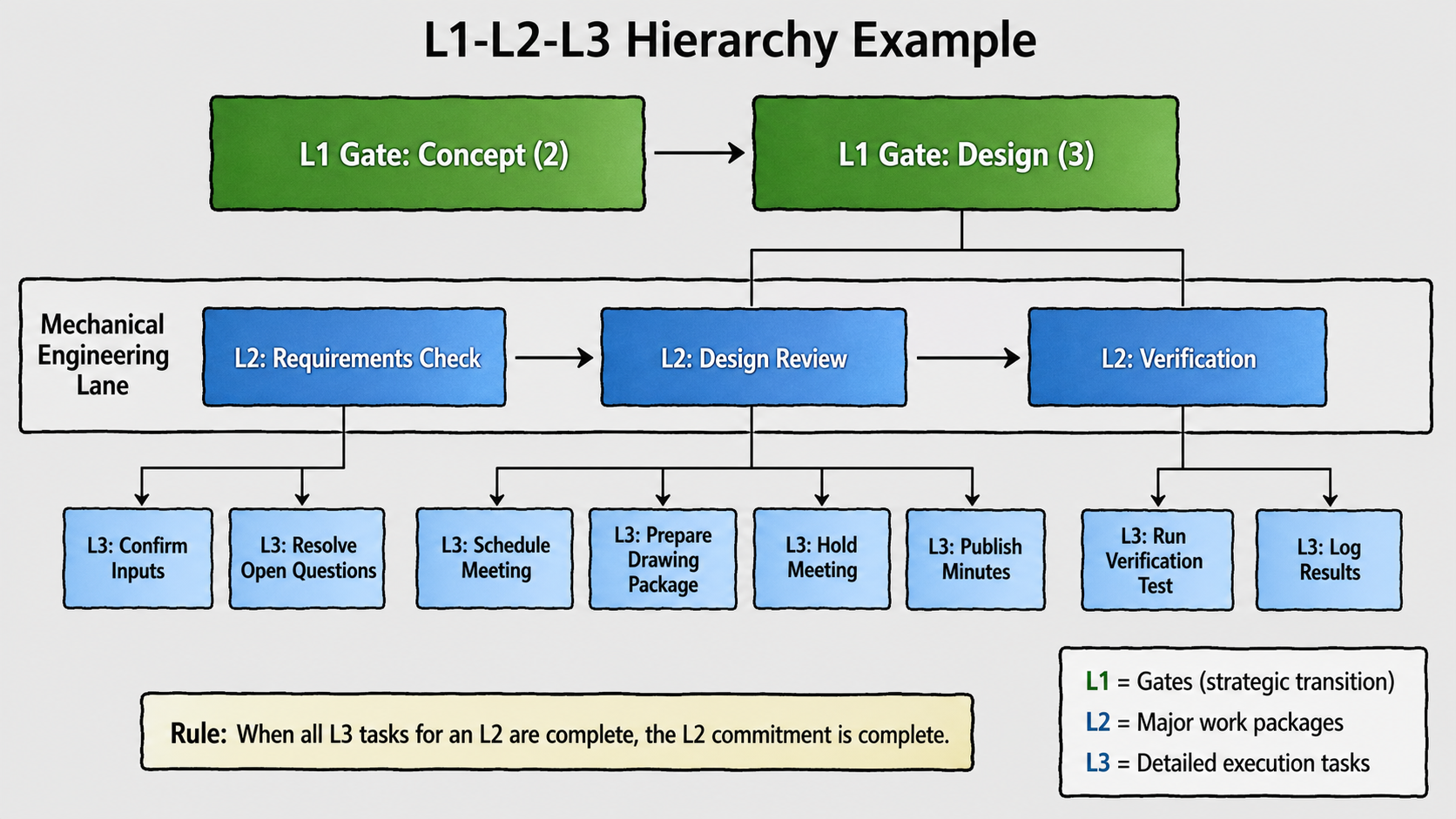
The Three Levels (L1, Level 2, Level 3)
- L1: Major project transition gates
Strategic control points such as concept freeze, design release, integration readiness, verification completion, and launch readiness. - Level 2: Major work packages
Multi-week chunks (often 2-4 weeks) owned by accountable functions. - Level 3: Detail tasks inside each Level 2
Multi-day work steps that build the Level 2 outcome. Typical ratio is 5-8 Level 3 tasks per Level 2 task.
The rule that matters: when Level 3 tasks are complete, the Level 2 commitment is complete. Same work surface, different granularity.
The Gantt Trees
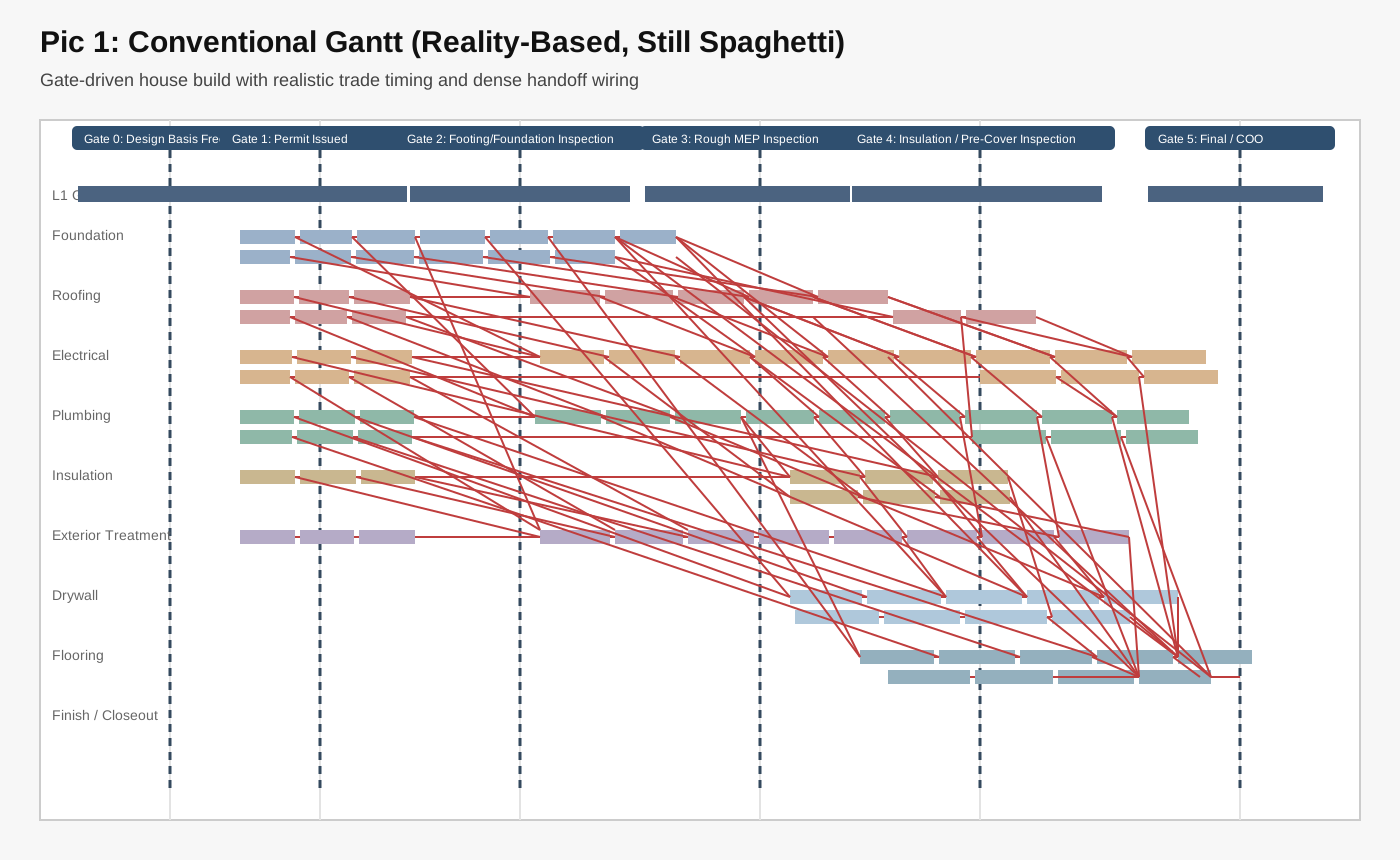
The project includes real gates, real functional detail, and real sequencing, but the dependency web is hard to navigate.
- You can see all the pieces.
- Cross-functional handoff points are hard to read.
- One schedule change can ripple unexpectedly through many links.
Most teams have lived this pattern. A Gantt plan starts with strong intent and clear organization. During planning, the detail is useful and often impressive: each task has owners, dates, and dependencies. But execution introduces reality. Vendors miss dates. Tests fail and need rework. Customer priorities change. Regulatory timing shifts. The plan can still be technically "correct" at a task level, but the dependency network stops behaving like a usable control system.
In the house-construction example shown below, those dynamics appear as permit and inspection timing shifts. In product development, the same dynamic appears at transition gates between concept, design, integration, verification, and release.
At that point, the chart becomes brittle. One local change triggers edits across many linked tasks, and teams either spend heavy effort rewiring dependencies or stop trusting the schedule as a living guide. The Gantt was a strong detail-planning tool at kickoff, but over time it can become less relevant to real coordination decisions because the forest is too dense to steer quickly.
The VPM Forest (Swim Lane View)
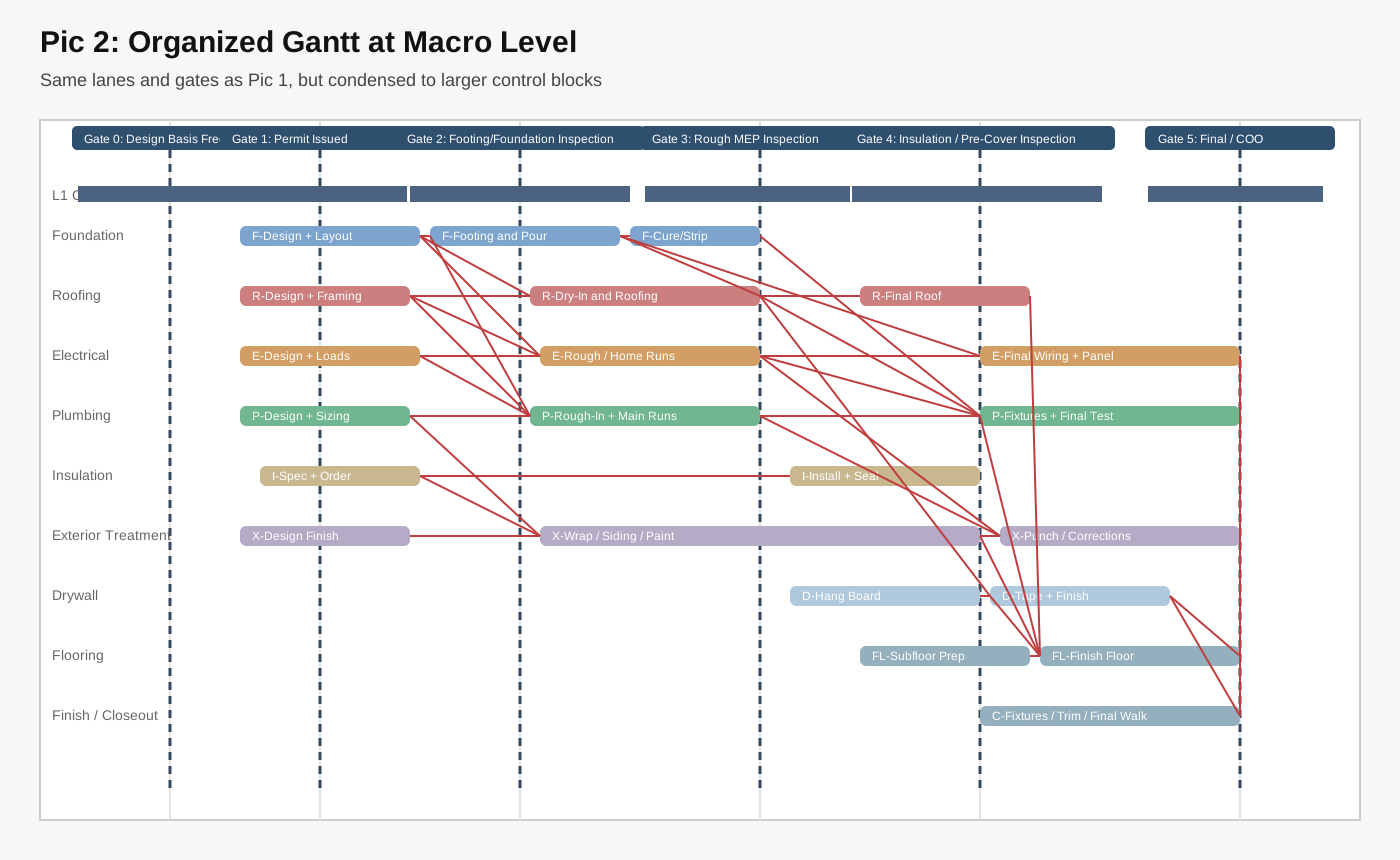
The same project surface is shown as larger Level 2 blocks across the same gates and lanes, with fewer leaders.
- The flow is readable in seconds.
- The main handoffs are visible.
- It is much easier to reason about change at the coordination layer.
Tradeoff: this view is clearer, but it no longer carries the full task-level grounding by itself.
This solves the Gantt forest problem, but introduces a new human problem: discomfort with lost detail. Work that feels concrete in a detailed schedule can feel abstract when it is represented as one box. A 75-hour effort across four people may now appear as a single macro block. Teams can worry that the model no longer reflects the reality of the work they own day to day.
Organizations often respond by bolting on side systems to manage detail, then manually syncing that detail back to the VPM Swim Lane view. In practice, this can mean invisible Gantt files driving the real work, or loosely linked action plans that drift from the published flow map. Sometimes that sync is disciplined; often it is late or incomplete under pressure. When that happens, teams carry two discomforts at once: the original discomfort of change plus a new discomfort from losing direct connection to their actual work detail. That tension can stall adoption even when people agree the flow view is better.
VPM Works: The Forest and the Trees
Neither view alone is enough. A traditional Gantt is excellent for initial planning and task definition, but it becomes brittle as change accumulates. A VPM Swim Lane flow view is excellent for agility and cross-functional steering, but it can lose direct connection to the detailed work if it sits above execution as a separate abstraction. So which one is better? In practice, neither by itself.
The answer is better together, but only if both are improved. The Gantt side must be architected cleanly instead of wired as unmanaged spaghetti. The VPM Swim Lane side must stay linked to real work product detail instead of replacing real execution with generic status boxes. VPM Works is that coordinated dual view: flow and work product aligned as one control system.
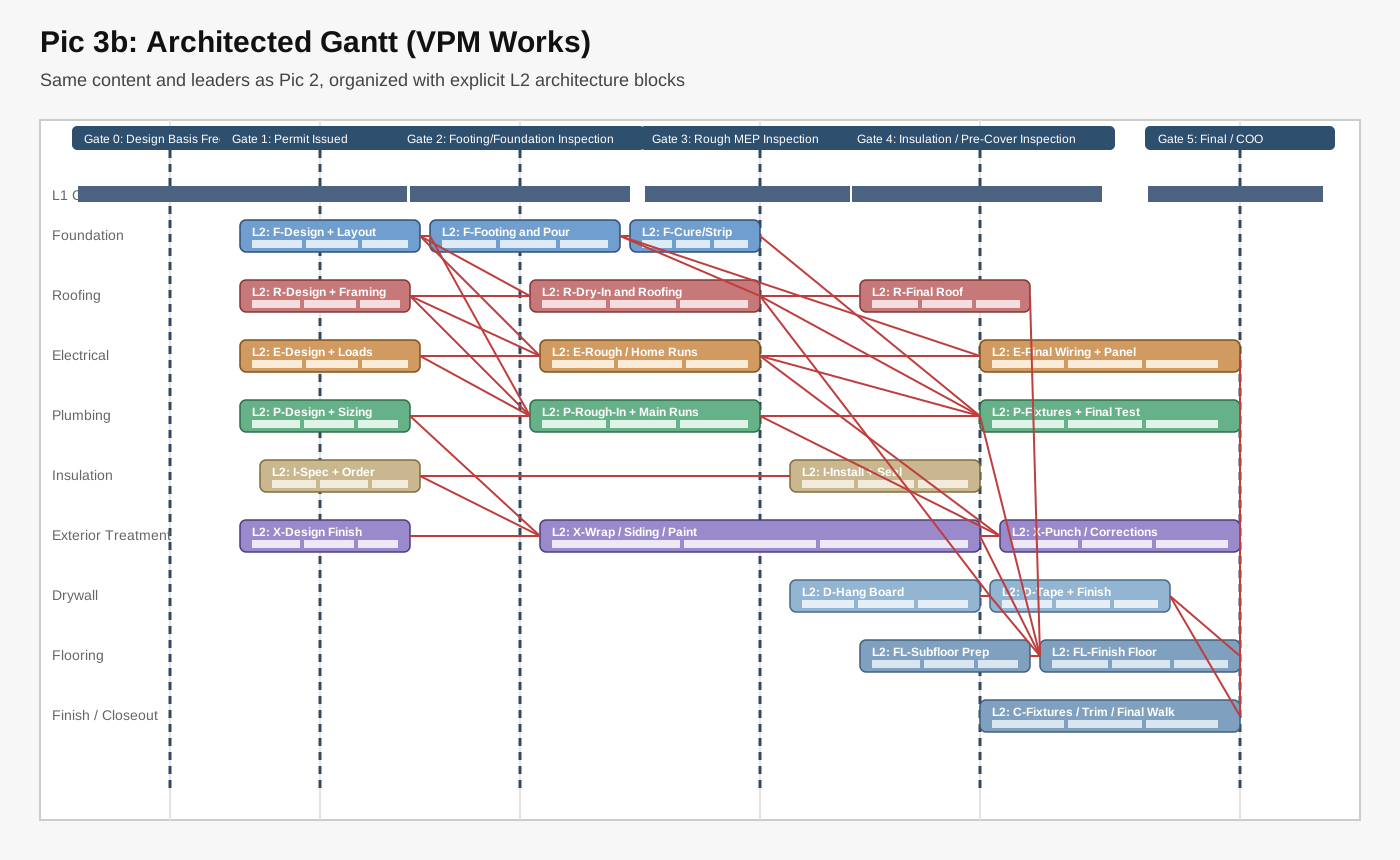
The VPM Works: The Forest and the Trees view uses the same gates, lanes, and leaders as The VPM Forest (Swim Lane View), but expresses the work as explicit Level 2 Summary Task blocks anchored to Level 3 detailed Deliverables.
- You can follow cross-lane flow like a VPM Swim Lane map.
- You can still trace each macro commitment to its detailed work context.
- Change navigation improves because flow is structured instead of ad hoc.
- As execution proceeds, Deliverables are updated to drive the Summary Tasks so the two stay linked through the project life.
Result: not less content, but better organization of the same project surface.
This is the key move. VPM Works: The Forest and the Trees is not a new plan and not a simplification layer that hides work. It is the same project surface, deliberately arranged so the macro flow is readable and the detailed work remains anchored underneath each block. Teams keep the information they need to execute while leaders keep the clarity they need to steer.
When change hits, this architecture changes the conversation. Instead of asking, "Which 80 links just broke?", teams ask, "Which Level 2 commitment moved, what downstream commitments are touched, and which Level 3 details inside that Level 2 need to be re-planned?" That is a faster, more stable control loop because it keeps scope and impact explicit.
Why This Differentiates VPM Works
This is the "software architecture vs spaghetti code" distinction applied to project plans:
- The Gantt Trees: what we have to do.
- The VPM Forest (Swim Lane View): flow so we can navigate change.
- VPM Works (Forest + Trees): flow that remains anchored to detailed work.
Traditional Gantt-only systems force a tradeoff between detail and usability. Forest-only VPM Swim Lane overlays can force a tradeoff between clarity and trust in execution detail. VPM Works removes that forced choice by treating architecture as part of planning, not decoration on top of planning.
This is the core differentiation. It is not a prettier chart and not just a communication tactic. It is a control architecture that preserves detail where teams need it, preserves flow where leaders need it, and keeps both synchronized as conditions change.