Project Scoreboard Beats a Newscast
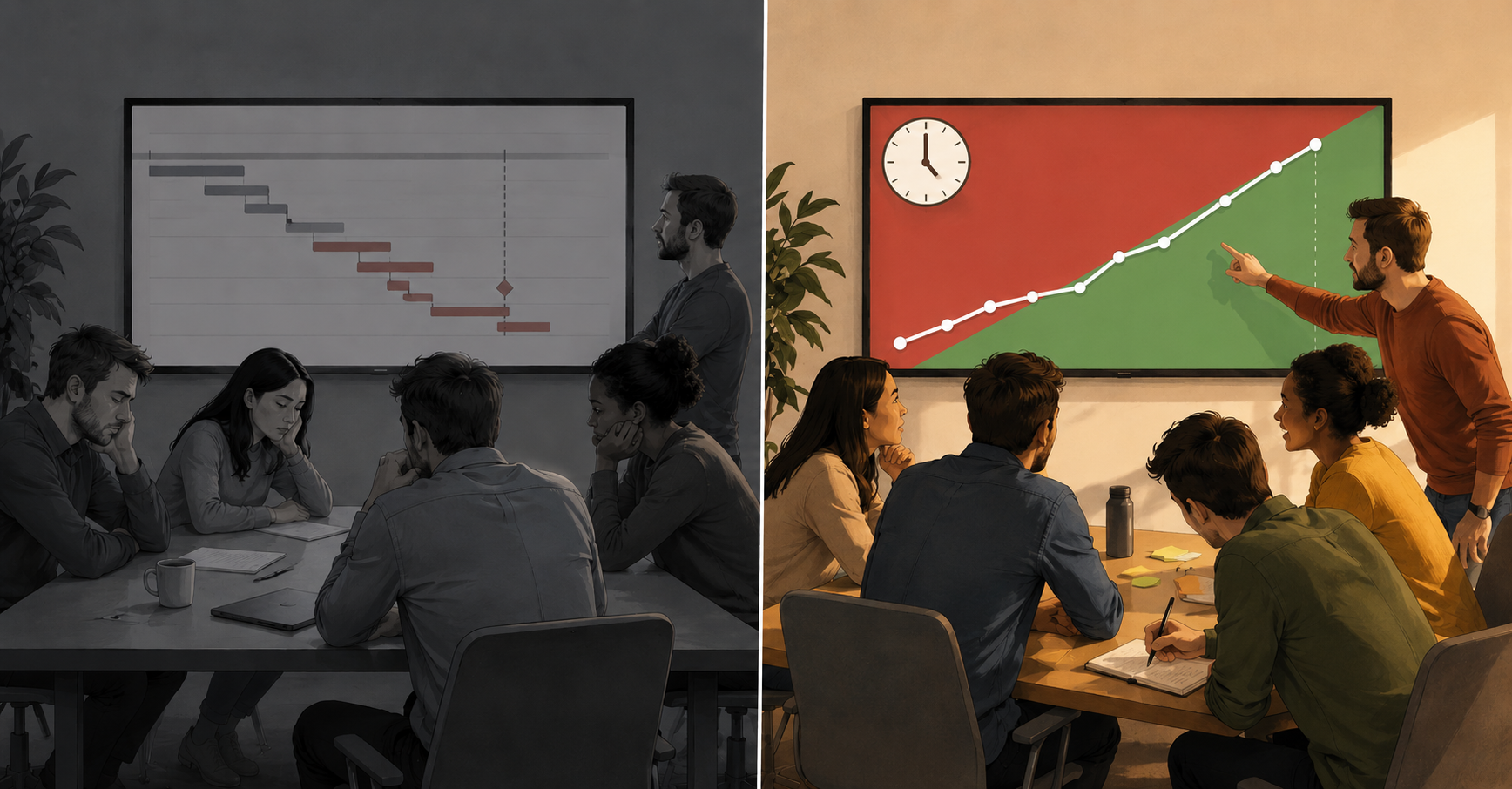
Watch a Gantt chart the moment a task slips: the bar simply extends. The end date drifts a day to the right, and nobody flinches. You've been informed. That's the tell — a Gantt reports change the way a newscast reports the weather. It happened, here it is, nothing for you to do.
The weekly status meeting is that newscast in human form. Someone reads the updates; everyone else sits and absorbs. Information flows one direction, and no one is asked to act.
A scoreboard works the opposite way. The number moves and the whole bench reacts — because the clock is running and the game is still winnable. Same information. Opposite behavior.
I've watched that one shift turn losing teams into winners: on-time delivery climbing from 30% to 85%, with the same people, in the same building. They didn't work harder. They changed what they looked at every morning — from a newscast to a scoreboard. (See Proof VPM Works.)
Most project tools, and most project meetings, are newscasts pretending to be scoreboards. Here are the five moves that turn the broadcast back into a game.

1. Make the game winnable
You can't ask a team to win a game you've rigged against them. Don't over-compress the plan into fantasy and call it "stretch" — set dates people can actually hit, and when a subject-matter expert tells you an estimate is unreal, fix the gap, not the messenger. Give the team reliable resources and steady priorities, and use buffer to move the odds in your favor instead of betting the date on everything going right. (Compress responsibly with compression techniques; build the right team in team selection.)
2. Field a team that owns its positions
A plan handed down by the PM is a plan nobody in the room agreed to. Build the schedule with the team present at the planning event, because people defend a plan they helped write — and own the commitments they made out loud. Then pin every handoff to a named owner with RACI, so when work crosses a boundary, there's no question who answers for it.
3. Hang an honest scoreboard
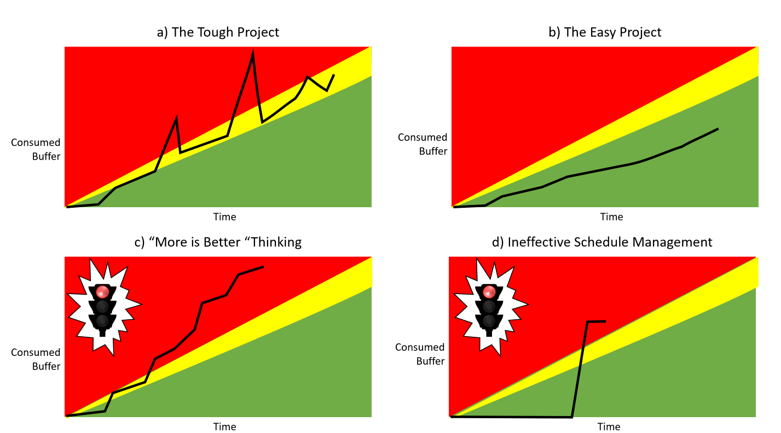
A scoreboard the CEO and the bench read differently isn't a scoreboard — it's two arguments waiting to happen. The fever chart turns "are we okay?" into a single green-to-red call to action everyone reads the same way. It only works if it's drawn from one source of truth; the moment status lives in three spreadsheets, the team argues about whose numbers are right instead of reacting to them. Pair it with the skyline view to see where you stand right now.
The shape of a fever-chart line is a fingerprint: one glance tells you whether the project is coasting in green, drifting into yellow, or burning red — no training, no interpretation, no status translation required. That instant, shared read is exactly what makes it a scoreboard and not a status report — the CEO and the bench see the same fingerprint, the same way, at the same moment.
4. Play every day
A scoreboard nobody looks at is wallpaper. The daily stand-up is the ritual that makes it live — the team gathers in front of the board, reads the score, and calls the next play. Short, visual, ending in a decision, not a recital of status. This is where the newscast finally dies: instead of reporting what happened, the team decides what happens next.

5. Study the film
Winning teams review why they lost the down. Every delay has a source; track it, Pareto the patterns, and fix the system that produced them with a disciplined root-cause pass — so the same slip can't beat you twice. It's the move most teams skip, and the one that compounds: a project that studies its own film gets harder to beat every phase.

Five moves, one shift. A newscast asks nothing of you — it reports a world you can't change. A scoreboard asks for your next move, because the game isn't over. Build the second one, and your team stops watching the project happen to them and starts playing to win it.